
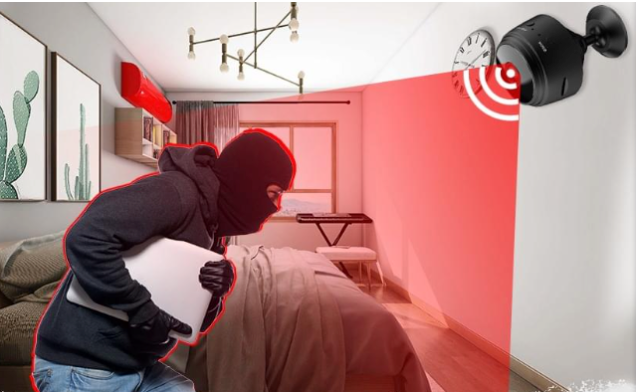
A security camera can protect your home. But an obvious camera can also give away information you never intended to share.
Walk toward a house with a doorbell camera, another camera mounted above the garage and one covering the backyard, and it doesn't take a security expert to figure out where the homeowner is watching.
Look a little longer and you may figure out something else:
Where they aren't.
That's an overlooked weakness in home security. We tend to think of cameras only in terms of the information they provide us. But their placement can provide information to someone else, too.
The Difference Between Deterrence and Detection
Visible cameras have an obvious advantage: people can see them.
Someone approaching your property may decide it's not worth the risk once they realize they're being recorded. That's deterrence, and there's real value in it.
But deterrence and detection aren't exactly the same thing.
Imagine someone repeatedly entering an area where they shouldn't be. Maybe tools have disappeared from the garage. Something keeps getting moved in a home office. Packages are disappearing from an interior entryway. You're noticing little things that don't add up.
At that point, putting an obvious camera directly over the area may change the person's behavior.
You might stop the activity.
But you might never discover what was actually happening.
That's where a discreet secondary camera can serve a completely different purpose.
The Blind Spot You Don't Notice Until You Need the Footage
Here's another problem with cameras: what you think they're recording isn't necessarily what they're actually capturing.
Stand beneath your own exterior camera sometime and look at its position.
Can it see someone's face as they approach?
What happens after they pass underneath it?
Does a parked vehicle obstruct part of the view?
What happens at night?
Could landscaping, a column, an open door or even bright light from another source interfere with the image?
A camera might capture someone entering your garage but lose sight of them once they're inside. A doorbell camera may clearly record a visitor approaching your front door while telling you absolutely nothing about what happened around the side of the house.
Security coverage isn't just about the number of cameras.
It's about perspectives.
And that's where a small, portable camera becomes interesting.
One Camera, Two Very Different Jobs
Think of your visible cameras as the first layer.
They're there to watch obvious approaches, record activity and let people know the property isn't completely unobserved.
A compact secondary camera like this one right here can perform another job.
It can watch an area without immediately announcing exactly where the observation point is.
That might mean placing one inside your garage while you're trying to figure out why things keep disappearing. It could mean temporarily monitoring a home office, workshop, storage area or another part of your own property where unexplained activity has occurred.
It could also provide a second angle on an area already covered by another camera.
That last part is more important than it sounds.
Suppose your main camera captures someone's back as they enter. A second perspective might capture their face.
One camera might show when someone arrived. Another might show what they actually did.
The objective isn't necessarily to hide cameras everywhere.
It's to eliminate the assumption that one camera equals complete coverage.
Portable Changes the Equation
Permanent security cameras are great at watching the same place every day.
But security problems aren't always permanent.
Maybe you're leaving home for a week.
Maybe contractors will have access to part of the house.
Maybe you've noticed something strange in the garage.
Maybe you want another set of eyes on a particular area temporarily without installing another permanent camera.
That's where portability becomes useful.
Instead of redesigning your entire security system whenever circumstances change, a compact camera can be repositioned based on the problem you're trying to solve.
Today it's watching one location.
Tomorrow it can watch another.
That makes it less like a permanent fixture and more like a security tool.
The Goal Isn't More Cameras
This is where home security can become unnecessarily complicated.
More equipment doesn't automatically mean better security.
What matters is whether your equipment answers the questions you actually care about.
Who came onto the property?
Where did they go?
When did it happen?
What did they do?
Can you clearly identify the person?
Is there an area your existing system simply doesn't cover?
Those questions are much more useful than asking how many cameras you own.
Sometimes the solution isn't another large, obvious camera mounted to the side of your house.
It's another perspective.
There's One Important Catch
A discreet camera should never become an excuse to ignore privacy.
Recording laws vary by state, especially when audio is involved. Certain areas also carry obvious expectations of privacy, and recording people there can create serious legal issues.
Before using any hidden or discreet recording device, understand the rules where you live and use it only on property and in situations where you have the legal right to record.
That's part of responsible security, too.
Look at Your Home Differently Tonight
Here's an interesting exercise.
Walk around your property and don't look at it like the person who lives there.
Look at it like someone trying to understand your security.
Find every visible camera.
Then ask yourself what each one can actually see—and what happens immediately outside that view.
Walk beneath them. Approach from different directions. Look at the property after dark. Notice where walls, vehicles, landscaping and furniture create gaps.
You may discover your cameras aren't covering quite as much as you thought.
And if there's an area where you'd like another set of eyes without advertising exactly where you're watching, a compact camera may fill a gap your permanent system can't.
Because visible cameras tell people they're being watched.
This discreet camera can help you discover what happens when they think they aren't.