
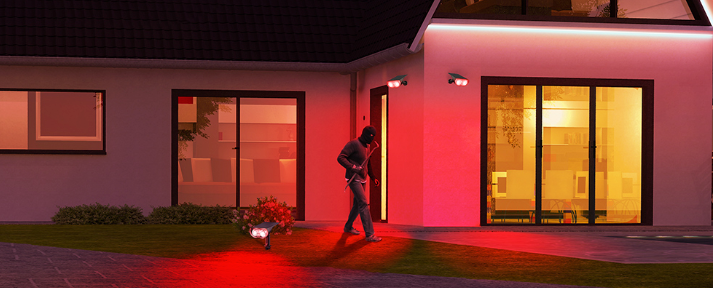
Motion-activated lights are one of those home-security upgrades that seem almost impossible to get wrong.
Mount the light. Point it toward the yard or driveway. Turn on the motion sensor. Done.
Except placement matters far more than most homeowners realize.
A motion light in the wrong location can illuminate an area beautifully while leaving the places you actually need to see completely dark. Worse, an overly bright or poorly aimed fixture can create glare and deep shadows that make it harder to see what is happening outside.
The goal isn't simply to make your property brighter. It's to put useful light where you need visibility, when you need it.
Here are some of the mistakes worth checking around your own home.
Brighter Isn't Automatically Better
One of the first mistakes is assuming the most powerful light provides the most security.
Imagine standing inside your house at night and looking through a window toward an extremely bright floodlight. Anything immediately around that light may be easy to see, but areas beyond it can appear much darker by comparison.
Your eyes are constantly adjusting to different levels of light. Large differences between brightly illuminated areas and surrounding darkness can make those darker areas more difficult to distinguish.
There's another problem: glare.
If a fixture is aimed toward a window, door, security camera, or the position from which you normally observe the property, some of that light may be coming directly back at you.
Instead of helping you see outside, you've essentially created a bright object between you and whatever you're trying to see.
A better test isn't standing underneath the light and asking, “Is this bright enough?”
Go inside at night and look outward from the places where you'd actually investigate a noise—the kitchen window, bedroom, front door, or security-camera feed.
What can you actually see?
That's a much better measure of whether the light is doing its job.
Your Camera and Your Eyes Don't See Light the Same Way
This is particularly important if you have security cameras.
A floodlight can look perfectly positioned to your eyes but produce a terrible camera image.
If an extremely bright portion of the scene is close to the camera, the camera may adjust its exposure for that bright area. The darker portions of the image can then lose useful detail.
You can end up with a beautifully illuminated wall, driveway, or porch column while the person standing farther away is difficult to distinguish.
There's an easy experiment.
Wait until it's completely dark and walk through the areas covered by your cameras. Trigger each motion light and watch the recorded footage afterward.
Don't just check whether you can see yourself.
Look at your face. Your clothing. What happens as you move from darkness into the illuminated area? Are there moments when you're mostly a silhouette? Does the camera struggle immediately after the light switches on?
Security lighting and security cameras should be tested as one system, not two unrelated products.
Stop Pointing Everything Straight Out
Many floodlights are installed high on a wall and aimed outward across the entire property.
That seems logical, but it isn't always useful.
Light that's thrown far into the yard may illuminate open space while leaving the area directly underneath the fixture surprisingly dark.
And that's often exactly where you need visibility: around the door, beside the garage, near a gate, or along the side of the house.
Look at your property in terms of approach paths, not square footage.
How would somebody naturally approach the back door? Where does the sidewalk meet the driveway? Is there a walkway along the side of the garage? What about the path between the driveway and front entrance?
Those are often better places to concentrate usable illumination than the middle of the lawn.
Corners Create Problems
Here's another detail that's easy to overlook.
Motion sensors don't necessarily provide perfect coverage simply because they're mounted high and facing outward.
Walls, shrubs, fences, columns, parked vehicles, sheds, and the geometry of the house itself can interfere with what the sensor detects or what the fixture illuminates.
Walk around your home at night and pay particular attention to transitions.
Can someone walk from the side yard toward the back without activating anything? Is there a dark strip between two fixtures? Does a parked SUV block illumination from reaching part of the driveway?
One large floodlight may look impressive from the street while leaving several useful areas untouched.
In some situations, multiple moderate lights positioned around actual walking routes can provide more useful coverage than one extremely bright fixture.
Landscaping Changes Your Lighting
A light you installed two years ago may no longer be illuminating the same area.
Why?
Your landscaping grew.
A small shrub can become a large bush. Tree branches spread. Vines climb fences. Seasonal foliage appears.
Eventually, vegetation can partially block either the light or sensor.
There's another issue with vegetation: movement.
Branches and plants moving close to a sensor can contribute to unwanted activations depending on the sensor, its settings, and environmental conditions.
Repeated false activations aren't merely annoying. They can train you to ignore the light.
If the backyard light activates twenty times because of ordinary movement, eventually “the light just came on” stops getting your attention.
So trimming vegetation around security lighting isn't only cosmetic. It's part of maintaining the system.
Don't Forget the Places Between the Obvious Places
Most homes have lighting around the front door, garage, and backyard.
The interesting question is what happens between those areas.
Consider the side gate.
The path behind the garage.
The location of your electrical panel.
The area around an exterior basement entrance.
The walkway between the driveway and backyard.
The portion of the house where trash containers are stored.
These aren't necessarily places where you need enormous floodlights. They're places worth examining because they're often unintentionally dark.
Walk your entire property after sunset instead of evaluating it from the driveway.
You'll see things you don't notice during the day.
Motion Detection Should Give You Time, Not Just Light
There's one final placement issue that makes a surprisingly large difference.
Ask yourself when the light activates.
If somebody walking toward your back door doesn't trigger the fixture until they're already standing on the porch, the light is reacting very late.
Ideally, the detection zone should cover the natural approach to the area you're protecting.
This is where adjusting sensor direction and sensitivity can matter more than buying another fixture.
You want useful detection without having every passing car, pedestrian, animal, or moving branch constantly triggering the system.
Finding that balance usually takes some experimentation.
Do a Night Walk Twice a Year
The easiest way to improve outdoor lighting doesn't require buying anything.
Twice a year, wait until it's completely dark and walk your property.
Approach your house the way a visitor would. Walk from the street to the front door, around the driveway, along each side of the house, and toward secondary entrances.
Then repeat the test while another family member stays inside watching through windows and checking the security-camera feeds.
You're looking for four things: areas that never trigger a light, areas where illumination arrives too late, excessive glare, and dark zones created by landscaping, vehicles, or the house itself.
You may discover that a fixture simply needs to be tilted downward. A sensor needs to be redirected. A branch needs trimming. Or one light would work better on another corner.
That's the overlooked lesson with motion lighting.
The goal isn't to have the brightest house on the street. It's to be able to see what you need to see.
A $40 light positioned thoughtfully can be more useful than an expensive floodlight pointed in the wrong direction.
And the only reliable way to know whether yours are positioned correctly is to stop looking at them during the day and see what they actually do in the dark.