
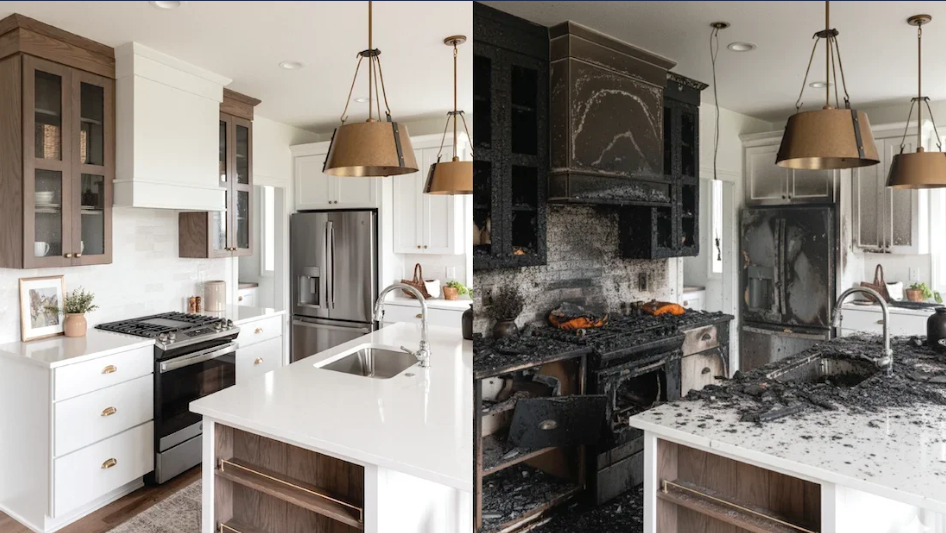
Most people assume a serious house fire starts with something dramatic. Faulty wiring hidden behind a wall. A lightning strike. A heater malfunctioning in the middle of the night.
But one of the most common places for a home fire to begin is somewhere you spend time almost every day.
Your kitchen.
And sometimes, all it takes is an ordinary distraction.
Imagine you're preparing dinner on a Friday evening. There's a pan heating on the stove, the television is playing in the background, and someone calls from the other room.
You step away for what feels like a few seconds.
When you return, smoke is rising from the pan.
Then you see flames.
Your first instinct might be to grab the pan, reach for water, or find something nearby to smother the fire.
Unfortunately, those split-second decisions can make a dangerous situation much worse.
That's why understanding how kitchen fires develop, what not to do, and which emergency tools are appropriate for different situations matters more than most homeowners realize.
1. The Most Dangerous Kitchen Fire Mistake Is Often Your First Reaction
Here's something that surprises many people.
Water, the very thing we normally associate with putting out fires, can make a cooking-oil fire dramatically worse.
When water hits extremely hot oil, it can rapidly turn into steam and throw burning oil outward. Instead of containing the flames, you may spread the fire across the stovetop, countertops, or surrounding area.
Moving a burning pan is another dangerous mistake.
A person might instinctively try carrying it to the sink or outside. But spilling burning oil while moving the pan can cause serious injuries and spread the fire.
For a small, contained cooking-oil fire, the safer approach may be to turn off the heat if you can do so without approaching flames, then carefully cover the pan with a properly fitting metal lid or baking sheet to cut off oxygen.
Leave the pan covered until it has completely cooled.
If the fire is spreading, producing heavy smoke, or cannot be controlled immediately and safely, evacuate everyone and call 911.
The important lesson is that a kitchen fire isn't something you should improvise your way through.
You need to know what works before the flames appear.
2. Your Fire Extinguisher May Not Be Enough
Having a fire extinguisher in the house is a smart precaution.
But there's a difference between owning one and being prepared to use it.
Think about where yours is stored.
Is it tucked behind cleaning supplies? Mounted somewhere in the garage? Hidden in a cabinet that rarely gets opened?
Now imagine trying to retrieve it while smoke is filling the kitchen.
Even after locating it, you need to know whether it's appropriate for the type of fire you're facing.
Different extinguishers are designed for different hazards. An ordinary household extinguisher may be suitable for certain small cooking fires, while deep-fat cooking equipment can require specialized protection.
And using an extinguisher incorrectly can create additional danger, including spreading burning oil.
This is why fire preparedness should involve more than buying equipment.
Everyone in the household should know where the equipment is located, what it's designed to handle, and when to abandon the attempt and leave.
A useful exercise: Ask another adult in your household to locate your kitchen extinguisher and explain how to operate it. If they can't do both confidently, you've identified a gap worth fixing.
3. The Simple Fire-Safety Tool Many Kitchens Are Missing
There's another option homeowners may want to consider for certain small, contained fires.
A fire blanket.
Unlike a traditional extinguisher, which discharges an extinguishing agent, a fire blanket is designed to cover a small fire and help separate it from the oxygen needed to sustain combustion.
Many are made from specially woven fiberglass and stored inside a compact pouch with pull tabs.
One example is the Prepared Hero Emergency Fire Blanket, designed as an additional household fire-safety tool.
Its appeal is straightforward: It doesn't require spraying powder or foam throughout the kitchen, and the flat pouch can be mounted somewhere accessible.
However, fire blankets aren't suitable for every fire. Their effectiveness depends on the fire's size, location, fuel, and the blanket's tested specifications.
They also require proper technique. Attempting to cover flames that are already spreading or reaching upward can expose someone to serious burns.
That's why a fire blanket should be considered an additional safety measure, not a replacement for smoke alarms, appropriate extinguishers, evacuation planning, or professional emergency assistance.
Take a closer look at the Prepared Hero Emergency Fire Blanket
Before purchasing one, check its applicable safety certifications, intended uses, dimensions, and manufacturer instructions.
4. The Placement of Your Fire Equipment Matters More Than You Think
Here's a mistake that can make even good emergency equipment less useful.
Storing it in the wrong place.
Suppose your fire extinguisher is mounted directly beside the stove.
At first, that might sound convenient.
But if flames are coming from the stovetop, you may have to move toward the fire to reach it.
That's the opposite of what you want.
Fire-safety equipment should be accessible without requiring you to pass through flames or place yourself in unnecessary danger.
The same principle applies to a fire blanket.
A compact pouch stored in a kitchen drawer may be easy to forget about. One mounted near an appropriate exit route may be easier to locate when needed.
Of course, every kitchen is different.
The goal is to identify a location that provides quick access while preserving a clear path out of the room.
Here's a simple test.
Stand where you normally cook and imagine a fire developing on the stovetop.
Can you reach your safety equipment without moving toward the flames?
Would another household member know where to find it?
Could you leave the kitchen immediately if the fire became too dangerous?
If the answer to any of those questions is no, consider changing your setup.
5. The Three-Minute Kitchen Fire Readiness Check
Most families never discuss what to do during a kitchen fire until one happens.
But you can identify several important weaknesses in just a few minutes.
Start with these five questions:
- Is our smoke alarm working, and can we hear it from the bedrooms?
- Do we have an appropriate fire extinguisher, and does everyone know where it is?
- Do we know why water should never be poured onto burning cooking oil?
- Is our emergency equipment accessible without approaching the stove?
- Does everyone know when to stop trying to control a fire, evacuate, and call 911?
Now consider one additional question.
If you weren't home, would the other adults in your household know what to do?
That's worth thinking about because emergencies don't necessarily happen when the person who purchased the safety equipment is nearby.
Your spouse, an older relative, or another adult preparing a meal may need to make decisions without your help.
A five-minute conversation today could prevent confusion later.
Is a Fire Blanket Worth Adding to Your Kitchen?
For homeowners reviewing their emergency equipment, a fire blanket may be worth considering as part of a broader preparedness plan.
The Prepared Hero Emergency Fire Blanket is a compact fiberglass-based option intended for certain small, contained fires.
Its design eliminates the need to discharge an extinguishing chemical, and its storage pouch makes it relatively easy to keep accessible.
But don't assume that a blanket can handle every type of fire or that using one is always safer than evacuating.
Before relying on any product, understand its limitations, read its instructions, and confirm that it is appropriate for the situations you're preparing for.
See the Prepared Hero Fire Blanket and review its features
A fire blanket should complement—not replace—properly maintained smoke alarms, suitable extinguishers, safe cooking habits, and a household evacuation plan.
The One Kitchen Habit That Could Prevent a Disaster
There's one final point that deserves more attention than any emergency product.
Most cooking fires are easier to prevent than to control after they start.
According to the National Fire Protection Association, unattended cooking is a leading factor in home cooking fires.
That means one of the most effective safety habits is also one of the simplest.
Stay in the kitchen when frying, grilling, or cooking with oil at high temperatures.
If you need to leave, turn off the burner.
Keep towels, packaging, and other combustible materials away from the stovetop. Use timers as reminders, but don't treat them as substitutes for supervision.
And if a fire does start, remember that protecting people is always more important than saving a meal, appliance, or kitchen.
A small fire can become dangerous quickly. When in doubt, get everyone outside and contact emergency services.
A Safer Kitchen Starts Before You Turn On the Stove
Nobody expects an ordinary dinner to turn into an emergency.
That's precisely why kitchen fire preparedness deserves a little attention.
You don't need to turn your home into a fire station or purchase every safety product advertised online.
Start by understanding the hazards.
Know why water and burning oil are a dangerous combination. Check your smoke alarms. Review your extinguisher. Make sure everyone knows the evacuation plan.
And consider whether a suitable fire blanket would be a useful addition to your existing equipment.
Learn more about the Prepared Hero Emergency Fire Blanket
Because the best time to discover that your kitchen safety plan has a weakness isn't when you're staring at flames.
It's right now, while everything is calm and you still have time to do something about it.
*Safety note: Fire blankets are not universally suitable for all fires, and improper use can cause serious injury. Never attempt to fight a fire that is spreading, producing heavy smoke, or blocking your escape. Evacuate and call 911. Always follow the instructions and limitations of your specific sa