
Most homeowners believe their house is reasonably secure.
They lock the doors before bed, keep a porch light on, and maybe have a camera watching the driveway.
But here's a question worth considering.
If someone approached your property tonight, how early would you know they were there?
Would you receive a warning while they were still in the yard? Would you know if a window had been opened? And if someone tried entering through a door while you were asleep, would you hear them before they got inside?
These are questions most people never ask until something happens.
The problem with traditional home security is that we tend to focus on protecting the front door while overlooking everything that happens before someone reaches it.
And during a widespread emergency, when power outages or delayed emergency services are possible, those overlooked weaknesses can become even more important.
That's why a layered approach to home security makes sense.
Instead of relying on one camera, one alarm, or one locked door, the idea is to create several opportunities to detect suspicious activity, discourage unwanted visitors, and give your household time to respond safely.
Here are seven areas worth examining around your property.
1. Your Backyard May Be the Biggest Security Blind Spot
Think about where most homeowners install their security cameras.
The front door.
Maybe the driveway.
But what about the side yard, rear entrance, or detached garage?
These areas can receive far less attention, especially when fences, landscaping, or storage buildings obstruct the view.
A useful first step is to walk your property after dark and identify the locations you cannot easily see from inside.
Pay particular attention to approaches leading toward doors, accessible windows, and outbuildings.
Motion sensors can provide an additional layer of awareness in these areas.
Some models detect movement using infrared technology, while connected versions can send notifications to a smartphone.
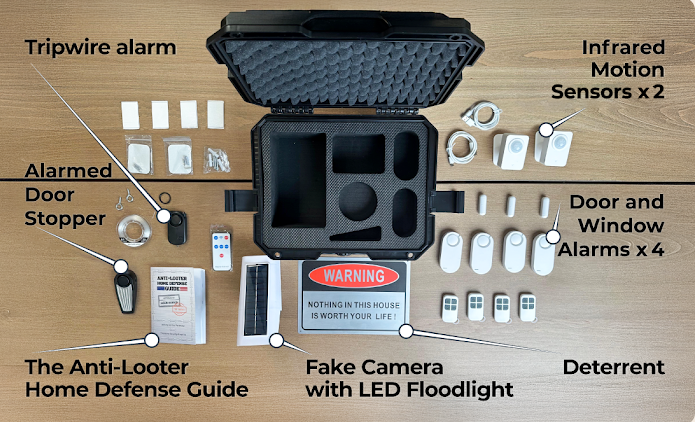
The Anti-Looter Kit developed by former CIA officer Jason Hanson includes two integrated motion sensors intended to help monitor selected areas.
Depending on the equipment's capabilities and configuration, motion-triggered alerts or connected lighting may help homeowners notice activity they would otherwise miss.
But placement is important.
A sensor facing moving tree branches, pets, or passing traffic may generate unnecessary alerts. One positioned too far from an entrance may not detect movement reliably.
The takeaway: Identify the two approaches to your home that receive the least attention. Those may be better locations for additional detection equipment than an area already covered by multiple cameras.
Explore the Anti-Looter Kit and its motion detection equipment →
2. You May Need an Alert Before Someone Reaches Your Door
Most door alarms are designed to activate after a door opens.
But what if you could receive an earlier warning that someone had entered a particular area of your property?
That's the concept behind perimeter warning devices.
The Anti-Looter Kit includes an early-warning tripwire alarm designed to produce an audible alert when its line is disturbed.
This type of equipment can be useful in certain controlled settings where you want to know when someone crosses a designated boundary.
However, there is an important distinction between an alert system and a physical obstacle.
A warning line should never be installed where it could trip, injure, or endanger someone. It must also comply with applicable laws and property rules.
For many homes, motion-activated sensors are a safer choice for frequently used paths, sidewalks, and entrances.
The larger lesson is about detection timing.
An alert that occurs before someone reaches an exterior door may provide more opportunity to assess what's happening, secure the household, and contact help if necessary.
The takeaway: Consider whether your existing security setup only tells you when someone reaches the house—or whether it gives you useful warning earlier.
3. The Door You Trust Most Could Use Another Layer of Protection
Here's an overlooked security issue.
Not every door in your home provides the same level of protection.
Your main entrance might have a quality deadbolt, reinforced strike plate, and camera.
But what about the door connecting the garage to the house?
Or a sliding patio door?
And what happens when you're staying somewhere unfamiliar, such as a hotel or vacation rental?
One portable option is an alarmed door wedge.
The Anti-Looter Kit includes a dual-function door jammer that combines a wedge-style doorstop with an audible alarm.
When compatible with the door and floor surface, this type of device can provide an additional warning if someone attempts to push the door inward.
But these devices have limitations.
Their effectiveness depends on the door's swing direction, the flooring, and how securely the device is positioned. They are not guaranteed to stop forced entry.
They should also never interfere with an emergency exit.
The takeaway: Check the doors you use less frequently. Make sure locks and frames are in good condition, and consider whether a suitable secondary alarm would improve your awareness.
4. A Power Outage Can Reveal Weaknesses in Your Security Setup
Modern home security has become increasingly dependent on electricity and internet connectivity.
Connected cameras, wireless alerts, smart locks, and automated lighting can all be useful.
But what happens if your neighborhood loses power?
Some systems include battery backup or cellular communication. Others lose certain features when the internet connection fails.
That's worth discovering before an emergency.
The Anti-Looter Kit includes a standalone-style floodlight designed to illuminate an area when movement is detected. Its housing resembles a surveillance camera, providing a visible security presence.
Before relying on any light during a blackout, however, confirm its actual power source, charging requirements, and expected operating time.
No lighting system should be assumed to work indefinitely without a dependable energy supply.
The takeaway: Test or review which of your security devices remain functional during an outage. You may find that one inexpensive backup provides more practical value than adding another internet-dependent camera.
5. Your Windows Need More Than Locks
Windows are often overlooked because homeowners assume a locked window is secure enough.
But locks only address one part of the problem.
Another question is whether you'd know if a window or door had been opened unexpectedly.
Small contact alarms can provide an audible warning when a protected opening is separated from its sensor.
The Anti-Looter Kit includes four door and window alarms along with two remotes, according to the product description.
These devices can be useful for selected entrances, particularly those outside your normal line of sight.
But don't assume every window needs an alarm.
Start with accessible ground-floor windows, rear entrances, and other locations that could be approached without attracting much attention.
And remember that a contact alarm generally detects an opening—not every possible method of entry.
The takeaway: Walk through your home and identify which doors and windows could open without anyone noticing. Prioritize those areas when considering additional alerts.
See the security devices included in Jason Hanson's Anti-Looter Kit →
6. The Right Warning Sign Can Help—But the Wrong One Can Create Problems
Many homeowners overlook the psychological side of security.
A property that appears monitored, maintained, and occupied may be less appealing to someone looking for an easy opportunity.
Visible cameras, working lights, and clear security signage can contribute to that impression.
The Anti-Looter Kit includes a visual deterrent sign with the message:
“Nothing in this house is worth your life.”
The intention is to discourage unwanted visitors without describing a specific response by the homeowner.
However, warning signs should be chosen carefully.
Threatening language can create unnecessary confrontation or potential legal concerns. A straightforward notice indicating that a property is monitored may be a more appropriate choice in many situations.
Signs alone also cannot replace actual security measures.
The takeaway: Review what your property communicates from the street. Does it look maintained and monitored? Are security notices clear without being threatening?
7. Your Emergency Plan Shouldn't Depend on One Person
Here's perhaps the most important weakness of all.
Many households have security equipment, but only one person understands how it works.
One family member knows how to arm the alarms, check notifications, or respond when a sensor activates.
Everyone else simply assumes that person will handle it.
But what happens when they're away?
A practical home security plan should be understandable to everyone old enough to participate.
That includes knowing how to recognize an alert, where to gather safely, when to contact emergency services, and why investigating a possible intruder alone can be dangerous.
The Anti-Looter Kit also includes a Home Defense Guide with installation instructions and additional preparedness topics.
Its broader theme is developing awareness of the areas around your home that may be overlooked.
A written guide can be useful, but the most valuable step is turning the information into a simple household plan.
The takeaway: Spend ten minutes explaining your home's security alerts and emergency procedures to other household members. Make sure they know that their priority is safety, not confronting an intruder.
What Is Jason Hanson's Anti-Looter Kit?
Jason Hanson is a former CIA officer who has developed and marketed personal security and preparedness products.
His Anti-Looter Kit brings together several types of equipment intended to help homeowners create additional layers of awareness and deterrence.
According to the product description, the package includes:
- Two integrated motion sensors
- An early-warning perimeter tripwire alarm
- A portable alarmed door jammer
- A motion-activated floodlight
- Four door and window alarms with two remotes
- A visual deterrent sign
- A protective tactical carrying case
- An Anti-Looter Home Defense Guide
The offer also advertises two preparedness publications: 75 Items That You Need to Stockpile Before the Collapse and The Most Effective Remedies That We Lost to History.
The contents, availability, and any included bonuses should be confirmed on the current offer page before purchasing.
The advantage of a bundled system is convenience. Rather than researching several separate devices, homeowners can examine a collection of tools intended for different areas of the property.
However, no collection of alarms can guarantee that a burglary or home invasion will be prevented.
Devices still need to be installed correctly, tested regularly, and supported by good security habits.
Review the Anti-Looter Kit, its contents, and current offer →
The 15-Minute Home Security Audit
Before spending money on any security system, here's a practical exercise worth doing.
Walk around your home and answer these five questions.
- Which entrances or approaches are not covered by my existing security equipment?
- Would I receive an alert before someone entered the house, or only afterward?
- Which security devices would continue working during a power or internet outage?
- Could another household member understand and respond appropriately to an alarm?
- Is there a safe, unobstructed way for everyone to leave the home during an emergency?
You might discover that your biggest weakness isn't a lack of equipment.
It could be a poorly positioned sensor, a rear window nobody checks, an alarm that isn't loud enough to wake you, or a system that becomes useless when the internet goes down.
These are problems worth identifying while everything is calm.
A Better Home Security Plan Starts With Early Warning
The goal of home security shouldn't be to turn your property into a fortress.
It should be to make your home less appealing to opportunistic intruders, recognize potential problems early, and give your family more time to reach safety.
That's where layered security becomes useful.
Motion sensors can help monitor approaches. Door and window alarms can provide warnings when protected openings are disturbed. Lighting may improve visibility. Portable alarms can add another layer in certain situations.
None of these measures is perfect on its own.
But when chosen carefully and combined with a clear household emergency plan, they can help address vulnerabilities that traditional locks and cameras may leave uncovered.
If you're interested in exploring a bundled approach, Jason Hanson's Anti-Looter Kit brings together several of the devices discussed in this article.
Take a closer look at the Anti-Looter Kit and see what's included →
Because protecting your home isn't just about what happens when someone reaches the front door.
It's about recognizing potential problems sooner, reducing avoidable risks, and making sure your family knows what to do when something unexpected happens.
Note: This article is for general home security and preparedness education. Security devices cannot guarantee protection against intrusion. Install equipment according to manufacturer instructions and applicable laws. Avoid hazardous traps or anything that could obstruct emergency exits. The availability, performance specifications, and promotional terms of the Anti-Looter Kit should be verified with the seller.